B2B and Organization Management
Nevis ID delivers IAM for organizations as a native part of the platform. Business partners are modeled as recursive units in a hierarchy with no fixed depth limit, and enterprise roles bundle application roles per tenant, so an entire organization's entitlements are granted and withdrawn in one place.
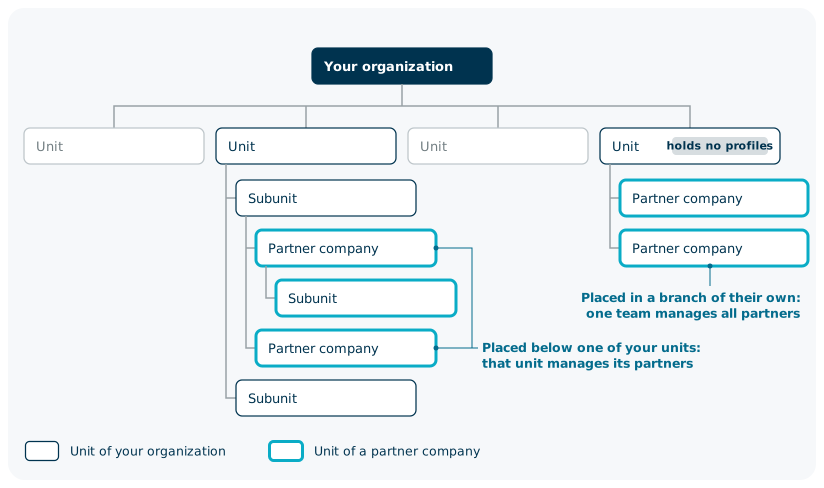
Each partner organization administers itself: a delegated administrator is scoped to their organization's unit subtree and nothing beyond it, on every interface including SCIM 2.0 (see Multi-tenancy and Delegated Administration). Partner organizations bring their own corporate IdP over OIDC or SAML.
Organization users can be provisioned just in time on first login, over SCIM 2.0 and REST, with social and OIDC federation creating the account directly in the organization's unit, or in bulk over the SCIM API. Nevis ID is the IdP layer of a partner-IAM (PIAM) stack: organization structures, roles, and provisioning are native.
Also known as
B2B capabilities, IAM services for organizations, partner IAM/PIAM, organizational hierarchy, B2B CIAM, B2B2C/B2B2E, JIT provisioning, access certification.
At a glance
| Capability | Details |
|---|---|
| Organizational hierarchy | Business partner organizations are recursive units in trees with no fixed depth limit; a unit moves with its entire subtree, and organization attributes propagate into sessions and tokens for downstream authorization |
| Enterprise roles | Tenant-specific bundles of application roles for organization-wide entitlements: adding a role to an enterprise role automatically grants it to every profile holding that enterprise role; fully administrable over the REST APIs |
| Delegated partner administration | A partner organization's administrator is scoped to their own unit subtree on every interface including SCIM 2.0; see Multi-tenancy and Delegated Administration |
| JIT provisioning | Accounts are created just in time in the organization's unit: over SCIM 2.0 with unit and enterprise-role assignment in one call, on first social or OIDC login, and over REST with the target organization computed at runtime; see also Integration, APIs, and Provisioning |
| Organization onboarding | Create the organization's unit, provision its first administrator, and bulk-load its users over the SCIM bulk API; admin-initiated invitation onboarding with expiring URL tickets is covered under Registration, Onboarding, and Identity Verification |
| Corporate IdP connections (BYOI) | Partner organizations bring their own IdP over OIDC or SAML; a corporate IdP connection can be pinned to a single Azure AD tenant, and multi-IdP routing selects the right IdP per request; see Federation and SSO |
| Federation restrictions | Trusted IdPs are explicitly registered per connection with certificate-based trust, and federated credentials can be allowed or denied per organization through unit policies |
| B2B2C and B2B2E | The same unit trees model consumer brands, partner companies, and their departments side by side in one instance, with tenants separating populations where full isolation is needed |
| Access certification | Not a native capability, by scope: Nevis ID is a pure IdP; certification campaigns, access reviews, and segregation-of-duties checks live in a dedicated IGA platform reading entitlements over the REST APIs |
| Audit of organization changes | Every administrative change, including unit and role changes, is recorded with actor and timestamp; see Reporting, Analytics, and Audit |
Concepts
- B2B organization structures: where a partner company sits in the unit tree, who manages it, and how its people get access
- Applications, roles, and enterprise roles: how enterprise roles bundle application roles for the people of an organization
- Client and tenant management APIs: tenants, units, roles, and authorizations, and how they relate
- Data model: the tenant entity as the data partitioning boundary of an instance
How-to Guides
- Work login with Google or Microsoft: just-in-time account creation on first federated login
- Migrate users over SCIM: bulk-loading user populations, including continuous synchronization
- API usage: technical users for organization provisioning, scoped to a tenant
- Federation: managing federation connections in the console
References
- Organization and role APIs: Create a unit, Move a unit, List child units, Enterprise roles of a client, Assign a role to an enterprise role, Create an enterprise authorization
- Provisioning APIs: Create a user (SCIM), Create an identity, Bulk operations
- JIT patterns: Social Login Create User and nevisIDM User Create
- Federation patterns: SAML IDP Connector with its selection expression for multi-IdP routing